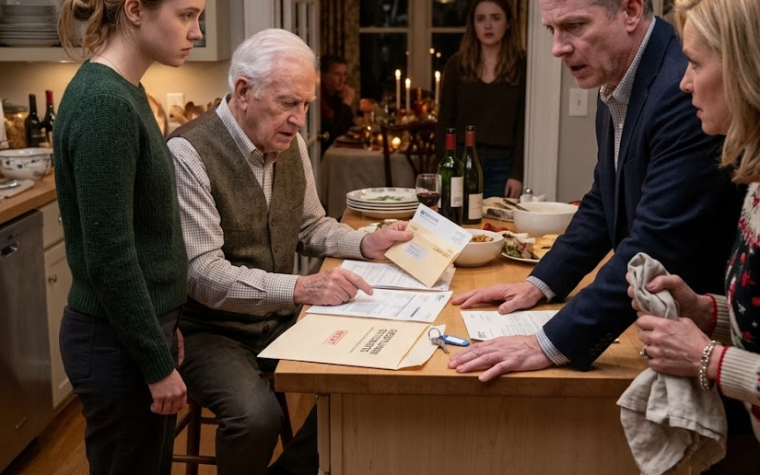
Evan: Then we use the panic attacks.
Vanessa: And if she tells them about the pantry?
Evan: She has no proof.
Vanessa’s hand flew to her mouth.
Evan stared at her.
“You said those messages were deleted.”
The words escaped before Marcus could stop him.
The judge heard them.
Everyone did.
Vanessa pulled my wedding bracelet from her wrist.
It slipped from her fingers and struck the table with a small metallic sound.
Marcus stood beside Evan, but he no longer looked like an advocate defending a client.
He looked like a man measuring the distance between himself and a collapsing structure.
“This material may have been unlawfully accessed,” he said.
“The account was jointly registered to Mrs.
Reed,” the judge replied.
“You may raise a proper evidentiary challenge at the full hearing.
Today I am determining whether an infant requires immediate protection and whether your client’s emergency allegations are credible.”
He turned another page.
That page was my son’s hospital discharge record.
It identified me as the parent authorized to take him home.
It stated that Evan had not visited, had not signed the birth acknowledgment and had not responded to two calls from the hospital’s family services desk.
A note documented that I had been discharged to a confidential recovery apartment arranged through the hospital after reporting domestic violence.
I had not kidnapped my baby.
I had followed the hospital’s safety plan.
The child Evan claimed I had hidden was the same child whose birth he had refused to attend, whose discharge calls he had ignored and whose mother he had tried to coerce before filing a petition built on her disappearance.
That was what I meant when I said my baby was the evidence.
His records fixed every event in time.
They showed when I arrived injured, when Marcus entered my room, when Evan issued his ultimatum, when my son was born and when the emergency petition was signed.
Evan’s story required those times not to exist.
But they did.
The judge closed the folder halfway and looked at Marcus.
“Your petition states that Mrs.
Reed has no stable residence.”
“That remains accurate,” Marcus said carefully.
“No,” I said.
“It doesn’t.”
I reached for the final envelope.
After Evan changed the locks at our marital home, the hospital advocate had helped me obtain temporary accommodation.
The lease was modest, but it was in my name.
Three months had already been paid from my separate savings account.
The envelope contained the lease, bank statements and photographs of the apartment’s sleeping space for my son.
I had a home.
I had arranged pediatric care.
I had a written plan for returning to work remotely after medical leave.
Evan had counted on the fact that I had stopped working during pregnancy at his insistence.
He had not counted on me keeping copies of the emails in which he demanded that I resign.
One of them read: My wife does not need her own income.
I will provide everything.
Another, sent months later, read: Without me, you have no job and nowhere to go.
The same dependency he had created was now being used as evidence that I was unfit.
The judge saw it.
“So your client pressured his pregnant wife to leave her employment, excluded her from the marital home, then cited her lack of employment and housing as grounds to remove her newborn?”
Marcus took several seconds to answer.
“My client disputes that characterization.”
“I imagine he does.”