It should have.
Noah deserved more care than our bank accounts.
By the time the final parenting plan was entered, Caleb had stopped using exchanges as opportunities to provoke me.
The court-required communication system had created something neither of us managed on our own: boundaries.
Noah remained primarily based in the home and school routine he knew, with scheduled time with his father.
Major decisions were structured.
Changes had to be documented.
Neither parent could simply announce a new reality and expect everyone else to accept it.
That last part felt almost poetic, though I never said so.
Vivian stopped inviting me to her mansion.
I considered that a gift.
She also stopped behaving as though the Whitaker Foundation belonged to her son by marriage.
At the next board meeting I attended, nobody asked whether Caleb would join me.
They asked for my vote.
The first time I sat in my father’s old place at the foundation table, I thought I would feel victorious.
I did not.
I felt tired.
Then I felt something quieter.
Safe.
Not because I had ruined Caleb.
I had not.
He still had a career.
He still had a future.
He was still Noah’s father, which meant his choices would remain connected to my life in ways no divorce decree could completely sever.
But he no longer controlled the version of me everyone was expected to believe.
Months after the gala, the foundation director gave me the original recording from my father’s study.
I watched the full version alone.
Near the end, after all the formal language about trustees, accounts, and succession, my father removed his glasses and looked into the camera.
His voice softened.
“Paper cannot make people good,” he said.
“It can only make the truth harder to steal.”
That was the line that broke me.
Not Caleb’s affair.
Not Maren’s pregnancy.
Not Vivian’s smile across that dinner table.
I cried for my father, because years before I needed it, he had understood something I had been too in love to see.
Protection was not suspicion.
A boundary was not cruelty.
And dignity did not always look like walking into a room and defeating someone.
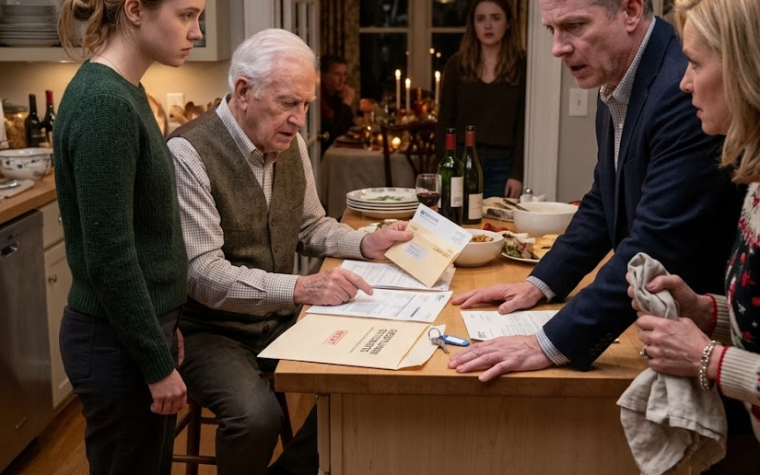
Sometimes it looked like sitting beside your sick child while a folder meant to frighten you rested on the table—and choosing to photograph it instead of tearing it apart.
Sometimes it looked like allowing a man to believe he had won because he filed first.
Sometimes it looked like opening the document he never bothered to read.
The family account was eventually replaced.
I chose a password Caleb would never know.
Noah’s tuition was paid on time.
On his first morning back at school, he ran ahead of me toward the doors with his backpack bouncing against his shoulders.
Halfway there, he turned around to make sure I was still behind him.
I raised my hand.
He smiled and kept going.
For a long time, I had thought restoring my dignity would require some grand moment when everyone who humiliated me finally understood what they had done.
The gala had given me something close to that.
But standing outside Noah’s school, I realized I no longer needed the room to understand.
Caleb had mistaken my silence for weakness.
Vivian had mistaken status for authority.
Maren had mistaken a bracelet for proof that she had won.
And I had once mistaken endurance for love.