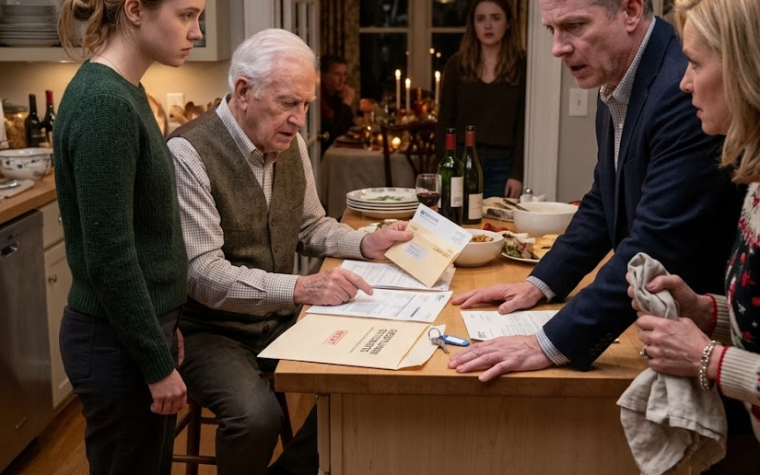
His fingers tightened around the envelope.
Then he looked at me.
For years, I had mistaken his need for control as decisiveness.
I had explained away the way he spoke over me, redirected money without discussion and treated disagreement as disloyalty.
Now the performance was gone.
What remained was a man standing outside a house he had called his, holding legal papers he had never imagined I would file.
“You think you won,” he said.
“No,” I replied.
“I think I survived Tuesday.”
The deputy guided him onto the porch.
Victoria and Natalie drove away first.
Ethan left in the patrol vehicle so the order could be formally processed and his statement taken.
When the door closed, the house became silent.
My attorney locked it and placed the key in my left hand.
I had held that key thousands of times.
That night, it felt heavier.
The next morning, a locksmith replaced every exterior lock.
My attorney arranged for a security company to preserve the doorbell footage and install additional cameras.
I canceled Ethan’s access to household systems and moved my recovery appointments to a clinic near my office.
The recording from dinner was copied, authenticated and transcribed.
Ethan’s attorney initially claimed the comments had been taken out of context.
Then he received the complete audio.
Victoria’s toast was clear.
“My son taught her a lesson.”
Natalie’s answer followed.
“She thought she was in charge.”
Ethan’s own voice connected my injury to the blocked transfer: “Maybe now you’ll stop interfering in family decisions.”
There was no missing context that improved those words.
At the protective-order hearing, Victoria testified that she had been using dark humor to relieve tension.
Natalie claimed she had not known my arm was actually broken.
The attorney questioning her placed a photograph of my sling on the evidence table and asked where I had been sitting during dinner.
Natalie admitted I had been directly across from her.
The recording was played.
When my voice said, “By stopping you from taking eighty thousand dollars?” Natalie could be heard answering, “It was a loan.”
There were still no loan documents.
The judge extended the protective order.
The financial investigation moved more slowly, but it moved with the same certainty.
The bank confirmed that Ethan had initiated the transfer using shared-account credentials after I had denied approval.
Because the transaction required dual authorization above a certain amount, the money had remained pending until I blocked it.
The lender confirmed that the signature attached to the home-equity application had come from Ethan’s device.
The application falsely identified him as an owner of the property.
Ethan argued that I had verbally authorized him to manage the refinancing.
His messages to Victoria contradicted him.
In one, he wrote that I would “sign once she understood she had no choice.”
In another, sent the morning after my injury, he wrote, “She won’t fight me again.”
Those messages ended any serious claim that he believed he had permission.
Natalie’s boutique collapsed within two months.
Without the eighty thousand, she could not cover overdue rent, vendor invoices and tax payments.
She blamed me publicly to relatives, but the records showed that the business had been failing long before I froze the transfer.
Victoria never moved into the east suite.
Through her attorney, she demanded access to furniture she claimed Ethan had promised her.
Receipts showed that I had purchased it.
She withdrew the demand.
The divorce did not end quickly.
Ethan disputed the property, the account restrictions and nearly every expense.
He insisted that years of living in the house entitled him to part of its value.