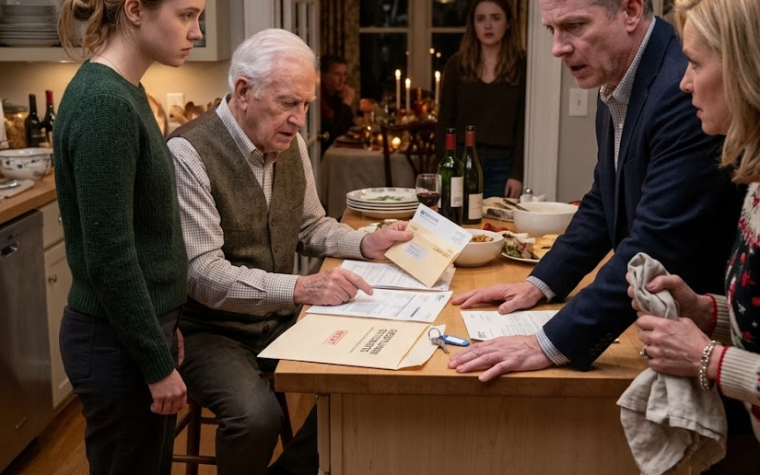
I read the circled sentence twice before I trusted myself to speak.
Urgent evaluation of the patient’s biological half-sibling was strongly recommended.
The words beneath it were colder and more precise.
Adrian’s ten-year-old son had an aggressive blood cancer.
Chemotherapy had pushed the disease back once, but it had returned.
His doctors believed a stem-cell transplant offered the best remaining chance.
Adrian, the boy’s mother, Lorraine, and every suitable person identified through the donor registry had failed to match closely enough.
My daughter had never been tested.
She was also the boy’s only biological half-sibling.
I turned the page.
There were laboratory reports, physician summaries, consent forms, and a letter requesting contact with the child’s legal guardian.
Much of the language was clinical, but the meaning was brutal.
Adrian had not come because he finally missed his daughter.
He had come because his son might die without her.
“Mom?”
My daughter’s voice came from the hallway.
I closed the folder before she could see the pages and stepped inside, forcing Adrian to remain on the porch.
She stopped several feet away.
Her dark hair was tied back, and she still held a pencil in one hand.
She looked from my face to the stranger beyond the door.
She had seen photographs of him.
I had never hidden the truth, but I had tried to give it to her in pieces she could carry.
She knew her father had left.
She knew he had another family.
She knew he had chosen not to visit.
Until that moment, she had never seen him in person.
Recognition moved across her face without warmth.
“Is that Adrian?” she asked.
He reacted as though she had struck him.
Not Dad.
Not Father.
Adrian.
“Yes,” I said.
He tried to smile.
“You look so much like—”
I shut the door before he could finish.
My daughter stared at the folder in my hands.
“Why is he here?”
I wanted to protect her from the answer.
I also knew that hiding it would repeat the pattern that had already harmed her.
Adrian and Lorraine had always treated her as though decisions about her could be made without her presence.
I would not do the same, even in the name of love.
“His son is very sick,” I said.
“The doctors are looking for someone who might be able to help him.
Because you share a biological father, they want to test you.”
Her gaze dropped to the folder.
“Test me for what?”
I explained as carefully as I could.
First there would be blood tests.
If she matched, doctors would discuss a stem-cell donation.
Nothing would happen without medical review, informed consent, and her agreement.
She could ask questions.
She could refuse.
No one, including me, would force her.
She listened without interrupting.
Then she looked toward the closed door.