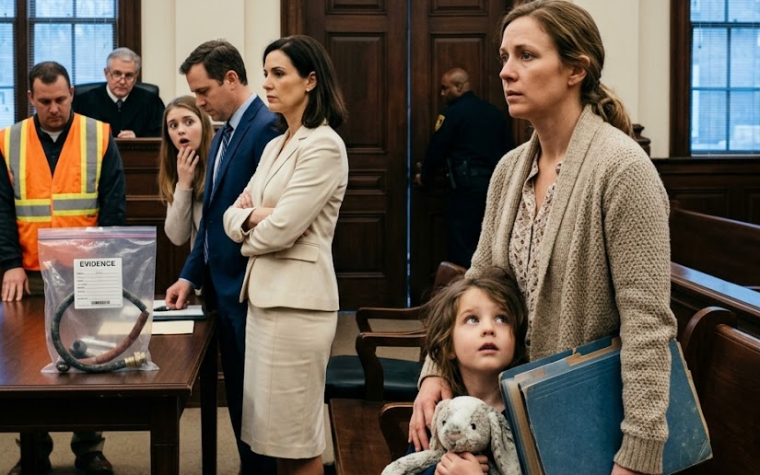
He called her ambitious, inexperienced, and desperate to reclaim attention from a family legacy that had moved on without her.
The words were cruel because they touched the doubt Nicky had carried into the room.
She had been away.
The family had changed.
Danny had built a life in Boston that did not require her.
Returning with a mysterious envelope and a theory had felt, even to her, like forcing open a door that might already be closed.
Mercer mistook that doubt for weakness.
Nicky took the microphone he had abandoned.
“I didn’t come here because I wanted attention,” she said.
“I came because someone believed the Reagan name still meant a promise would be kept.”
She looked at the families seated near the back—parents whose children used the Harbor House gym, students who studied in its classrooms, volunteers who had repaired the roof after winter storms.
“This building was protected before any of us entered this room.
The people who wrote that trust knew money would eventually arrive with plans, deadlines, and polished speeches.
They also knew a community can lose something forever while everyone responsible insists the paperwork was proper.”
Mercer interrupted.
“This is sentiment, not law.”
“The law is in the folder,” Nicky said.
“The sentiment is why it matters.”
The inspector general ordered the deed, recorder, archive report, and Nicky’s phone preserved as evidence.
She also announced an immediate freeze on the Harbor House sale.
The applause that followed was not polite or controlled.
It rose from the families first, then from volunteers, staff members, and even several donors who had been invited to celebrate Mercer’s project.
Mercer went pale.
Sloan looked toward the exits.
Neither man was arrested in the hearing room.
The evidence still required authentication, interviews, and a full legal process.
But their power ended there.
Within forty-eight hours, the voice recording was verified as unaltered.
The electronic deed was traced to a workstation controlled by Sloan’s office.
Investigators found payments routed from a Mercer subsidiary to the notary through two consulting firms.
Security footage from the municipal archive showed Sloan entering the records room on the night the trust file was replaced.
Elena Vale was found three days later staying with a relative outside the city.
She had not been kidnapped or physically harmed.
She had fled after receiving threats that Harbor House would be closed and blamed on her if she spoke publicly.
The anonymous envelope had been mailed by Elena herself.
She chose Nicky because she had watched her grow up challenging powerful people at the Reagan dinner table without abandoning her family.
Elena believed Nicky would understand that loyalty did not mean silence.
The redevelopment agreement was voided.
Sloan was suspended, then dismissed after an internal proceeding confirmed misconduct.
Prosecutors charged him with falsifying public records and conspiracy.
Mercer’s company lost its city contracts while fraud and bribery charges moved through court.
Danny was formally cleared of authorizing the sale.
But the public clearing did not erase what happened between him and Nicky.
Two nights after the hearing, they sat alone inside Harbor House.
Folding chairs were stacked against the wall.
Fresh paper covered a broken window, and the basketball court smelled faintly of floor wax and rain.
Danny placed two containers of takeout food on a small table.
“It isn’t Sunday dinner,” he said.
Nicky opened one container.
“The portions are too small.”
He almost smiled.
Then the silence returned.
Danny looked down at his hands.
“I should have listened to you.”
“You should have let me finish one sentence.”
“I thought I was protecting you.”