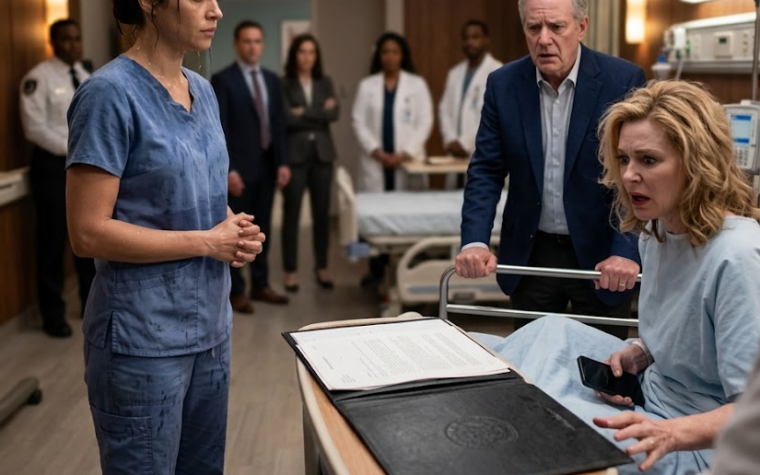
The surgeon opened the full report and angled the tablet toward me.
For several seconds, nobody spoke.
I had spent four decades looking at test results, scans and charts.
I knew the danger of seeing what you expected to see, so I forced myself to look at the images as a physician before I looked at them as a grandmother.
The current fracture was clear.
What made my stomach tighten was what sat beyond it.
There were signs that her arm had been injured before.
Not the fresh break that had brought her into the emergency room that night, but older changes in the bone—healed damage that demanded an explanation.
The surgeon kept his voice low.
“I asked radiology to review the images again.”
I looked at my granddaughter.
She had gone completely still.
“Did anyone know about the earlier injury?” I asked.
Her eyes moved toward the curtain separating us from the hallway.
Then she shook her head.
“I didn’t come here.”
Those four words changed the room.
I had suspected there was more behind the long sleeves and the flinching.
Suspicion, however, is not the same thing as evidence.
Fear can make a grandmother imagine the worst.
A pattern on a scan is different.
A child’s own account is different.
The surgeon pulled a stool closer.
“I need to ask you some questions,” he told her.
“You can answer only what you feel able to answer.
Your grandmother may stay if you want her here.”
She kept hold of my hand.
“Stay.”
So I stayed.
He asked when the earlier injury happened.
She hesitated, then described an evening months before.
There had been an argument at home.
She had been grabbed.
She had struck her arm hard against the edge of a piece of furniture.
For days afterward, moving it hurt.
Her mother had noticed.
That was the moment I stopped looking at my granddaughter and looked toward the closed curtain.
“What did your mother say?” the surgeon asked.
“He said it was just a bruise.”
“And your mother?”
Her voice became smaller.
“She said we’d see how it felt in the morning.”
“Did anyone take you to a doctor?”
“No.”
The surgeon’s mouth tightened.
He didn’t need to tell me what happened next.
Hospitals have procedures for situations like this.
They exist precisely because frightened families are often too tangled in loyalty, shame and dependence to protect the most vulnerable person in the room without help.
He told my granddaughter that a social worker would speak with her and that, because of what she had disclosed and what the medical findings suggested, the hospital had obligations that did not depend on whether her stepfather wanted them involved.
For the first time that night, she looked surprised.
“He can’t make me leave?”
The question nearly broke me.
I kept my voice level.
“Not before the people responsible for your safety understand what happened.”
Outside the curtain, a chair scraped sharply across the floor.
My son-in-law had heard enough to realize the visit was no longer going according to his plan.