One transfer had been initiated the day the transplant team confirmed that I was a compatible donor.
Another had been completed while I was still in the recovery unit.
The final picture showed a page titled with my name.
Beneath it, Nick had listed phrases that later appeared almost word for word in his custody filing: emotional instability, impaired judgment, medication dependence, unpredictable behavior, inability to maintain a home.
Beside the list was a reminder written in his handwriting: document everything after surgery.
Nick finally stood.
“This is absurd.
A child photographed private legal documents she couldn’t possibly understand.
Rachel must have put her up to it.”
The judge looked at me.
“Did you know these photographs existed?”
“No, Your Honor.”
My voice cracked, but I forced myself to continue.
“I didn’t know the divorce petition existed until it was served.
I didn’t know he had started moving money before my surgery.
I didn’t know he was speaking to Chloe about the case.”
Nick pointed toward me.
“She’s lying.
Look at her.
This is exactly the instability I described.”
For fifteen years, I had watched him win arguments by staying calm while the other person became upset.
He mistook composure for truth and pain for guilt.
This time, the judge did not look at me.
He looked at Nick.
“Sit down.”
Nick kept talking.
“You’re allowing a child to destroy a father’s rights with secret recordings.”
“Sit down, Mr.
Hale.”
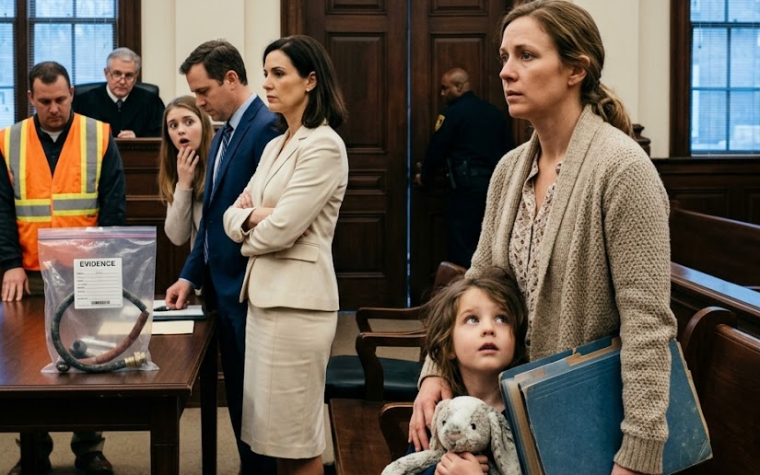
The bailiff stepped forward.
Nick finally obeyed.
The judge suspended the custody trial.
He issued an immediate order placing Chloe temporarily with me and prohibiting either parent from discussing testimony with her.
Because I was still recovering at my sister’s house, the order allowed Chloe to remain there with us until further review.
He froze the transferred funds, ordered both sides to preserve all financial and electronic records, and appointed a forensic accountant to trace the money.
He also assigned an independent child advocate to speak with Chloe away from both parents.
Nick’s request to take Chloe home that afternoon was denied.
As we left the courtroom, he stood behind his table looking less like the man who had beaten me and more like a man who had just discovered the rules applied to him.
In the hallway, Chloe began crying.
“I’m sorry, Mommy.”
I lowered myself carefully to her height.
Every movement still pulled at my incision.
“You have nothing to be sorry for.”
“I listened when he told me not to.”
“You listened to yourself when something felt wrong.”
“He said you’d hate me if you knew I kept secrets.”
I wrapped my arms around her.
“There is nothing you could show me that would make me stop loving you.”
My sister drove us home.
Chloe fell asleep in the back seat with the sleeve of my sweater clenched in her fist.
That night, I finally cried—not because Nick had left me, but because our daughter had been trying to protect me while I was supposed to be protecting her.
The investigation lasted four months.
The forensic accountant found that Nick had begun moving marital funds shortly after learning I was a donor match.
He had opened an individual account, redirected income, and transferred enough from our joint savings to make it difficult for me to retain counsel.
Some of the money had paid Daniel’s retainer.
The rest remained under Nick’s control until the court froze it.