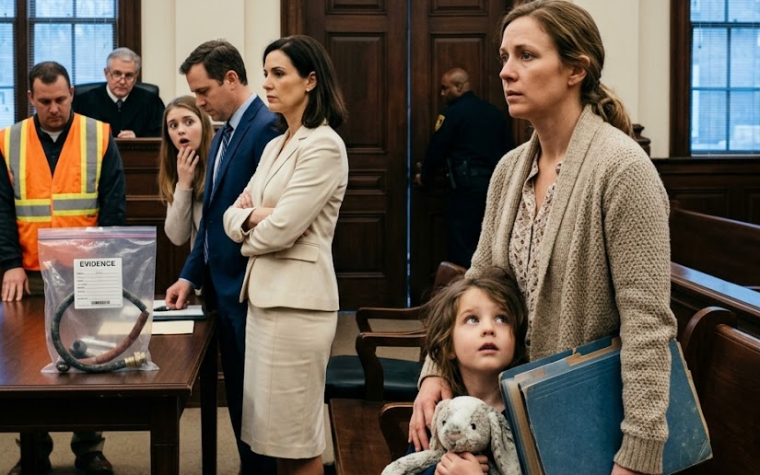
The final divorce hearing took place four months later.
The court found that Julian had intentionally concealed marital property, submitted materially misleading disclosures, and dissipated marital funds for the benefit of a second household.
The disputed transfers were brought back into the marital estate for division.
I did not receive everything, nor did I ask for it.
I received the marital home, which I later sold because I did not want to raise my son inside rooms built around betrayal.
I received my equitable share of the business value, repayment for diverted marital funds, secured child support, and coverage for our son’s medical needs.
A portion of the money held in the little girl’s legitimate custodial account remained protected for her.
Judge Thornton made clear that the child would not be punished for the way adults had used her name.
The fraudulent transfers connected to Julian’s personal purchases were reversed.
His control over several business accounts was restricted, and the financial findings were referred for further review by the appropriate authorities.
Vanessa lost access to the house she had expected to inherit from my marriage.
Her relationship with Julian collapsed under the accusations they had traded in court.
But the consequence that seemed to affect Julian most was quieter.
The little girl no longer trusted him.
Through counsel, I learned that she had begun asking adults whether telling the truth would make people leave.
She slept with the stuffed rabbit every night but refused to allow anyone to repair the torn seam.
I thought about her often.
On the day the divorce became final, Judge Thornton asked whether I understood the settlement.
“Yes, Your Honor.”
“Are you entering it voluntarily?”
I looked at the signature line.
Months earlier, I had believed dignity meant walking away without demanding anything.
I had confused surrender with freedom because I was too tired to imagine another kind of strength.
Now I understood that refusing to fight would not have erased Julian’s betrayal.
It would only have rewarded the structure he built from it.
“Yes,” I said.
“This time, I understand exactly what I am signing.”
I signed my name.
Julian signed after me.
His hand shook slightly.
Outside the courthouse, Boston traffic moved beneath a clear afternoon sky.
My son slept against my chest, warm beneath his blanket.
My attorney carried the final folder but handed it to me before we reached the steps.
I held it for a moment, feeling its weight.
Then I saw the little girl across the plaza with Vanessa.
She still carried the gray rabbit.
Vanessa noticed me and looked away.
The child did not.
She stared at the baby, then lifted one hand in a small, uncertain wave.
I waved back.
Neither of us approached the other.
There was too much history between the adults and too little responsibility belonging to the children.
But before Vanessa led her away, the girl touched the rabbit’s torn seam and gave me the faintest smile.
She had entered the courtroom believing silence protected her family.
Instead, her truth protected two children from inheriting the cost of Julian’s lie.
I watched her disappear into the crowd, then placed the divorce folder inside my bag.
The house was gone.
The marriage was finished.
The future I once imagined had collapsed.
Yet for the first time in months, I did not feel as though I was leaving with nothing.
I carried my son down the courthouse steps with my name, my security, and my dignity restored—not because someone had rescued me, but because a frightened little girl had found the courage to speak before I surrendered them.