The email disappeared from my screen with a quiet electronic chime.
For several seconds, nothing changed.
Clara remained asleep beneath the hospital blanket.
The monitor beside her continued its steady rhythm.
Snow tapped against the dark window, and my hand remained trapped beneath her small fingers.
But somewhere across town, five videos had just landed in the superintendent’s inbox.
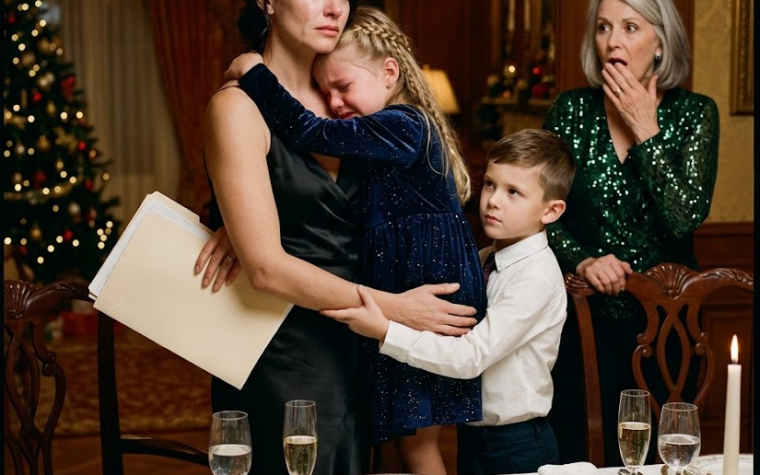
The first showed my father crossing the living room and kicking Clara in the face.
The second captured my brother laughing as she fell.
The third showed my father dragging her toward the door while I screamed at him to stop.
The final two showed Clara barefoot in the snow as the guests applauded from inside.
I sent the same files to the detective whose card a nurse had placed beside me.
Then I forwarded them to a secure account I had created, uploaded copies to protected storage, and wrote down the names of every person visible or audible in the recordings.
I had spent my entire life being told that I was too emotional.
That night, I became methodical.
Two police officers arrived before dawn.
One spoke with me while the other waited outside Clara’s room so she would not wake to a crowd of uniforms.
I told them everything from the moment we entered my parents’ house.
I described the stuffed rabbit, my nephews taking it, my father’s expression when he saw Clara crying, the kick, the locked door, and the applause.
I did not soften a single detail.
When the detective watched the first video, his jaw tightened.
He replayed the kick once, then stopped the recording before Clara hit the floor.
“How long was she outside?” he asked.
“I don’t know exactly.
It felt endless.”
“The videos may help establish the time.”
One clip began when the door closed.
Another continued until I forced it open.
Their timestamps placed Clara outside for several minutes in freezing weather—long enough for the doctors to diagnose mild hypothermia and early frostbite.
The hospital records provided what the videos could not: her temperature, the loss of sensation in her feet, the swelling across her cheek, and the blood vessels broken beneath one eye.
The detective photographed Clara’s red dress, her damp socks, and the coat I had wrapped around her.
He collected the clothes in paper evidence bags after the nurses brought replacements.
Before leaving, he looked at me and said, “Do not delete anything.
Do not negotiate with your family.
Save every call, message, and voicemail.”
My phone was already vibrating.
My mother called six times.
My brother called four.
My father called once.
I let every call go to voicemail.
My mother spoke first.
Her voice was sharp and offended, as though I had ruined her party by taking my injured child to a hospital.
“You have made this into something ugly,” she said.
“Your father was trying to teach Clara resilience.
You need to come home before outsiders get involved.”
Outsiders were already involved.
A doctor had documented my daughter’s injuries.
Police had opened an investigation.
The superintendent had confirmed receipt of my email with three words: I am reviewing.
My brother’s first voicemail was worse.
“You need to calm down,” he said.
“Dad barely touched her.
Those clips look bad without context.
Do not send them anywhere until we talk.”
His second message arrived eleven minutes later.
“I know how these cases work.
You are going to traumatize Clara more by turning this into a criminal matter.”