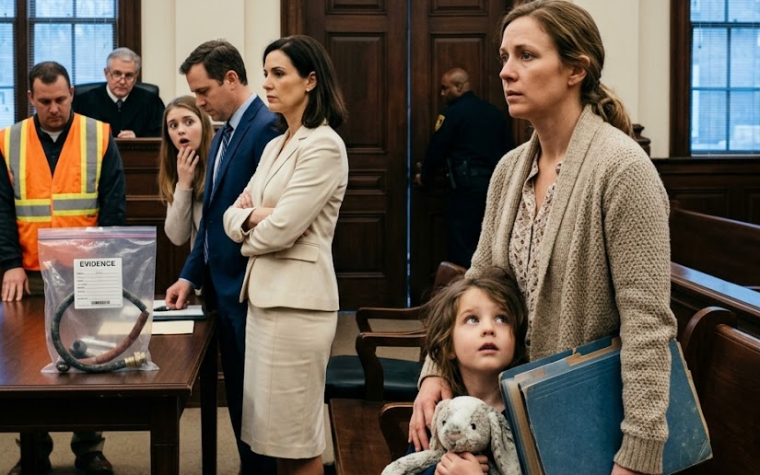
The judge unfolded the final page, adjusted her glasses, and read the sentence that ended my husband’s performance of certainty.
“I hereby designate her as beneficiary of fifty-one percent of the voting interest in Whitaker Advisory Group and appoint her managing director upon acceptance.”
Nobody moved.
The old clock above the courtroom doors clicked once, painfully loud in the silence.
My husband’s hand was still wrapped around his attorney’s sleeve.
He released it slowly, as though he had only just realized everyone could see him holding on.
“That’s impossible,” he said.
The judge looked over the document.
“Mr.
Whitaker’s estate counsel has provided the executed trust amendment, board resolutions, probate authorization, and proof of service.
You and your attorney received copies at eight twenty-seven this morning.”
His attorney opened the electronic file on his tablet, scrolling too quickly to pretend he had already reviewed it.
My daughter looked up at me.
I could feel the question in the way her fingers tightened around mine, but I had no answer ready.
I had known Eleanor was ill.
I had sent cards, called when she felt strong enough to speak, and visited once during the final month of her life.
She had asked about my daughter, my divorce, and whether I planned to work again.
I told her I hoped to.
She had smiled faintly from beneath a gray blanket.
“Hope is not a plan,” she said.
“You taught me that.”
I thought she was reminding me to update my résumé.
I never imagined she was preparing to return an entire future to me.
The judge continued reading.
Eleanor’s shares were held in a trust created before my marriage.
The transfer became effective only after the probate court confirmed the successor provisions that morning.
The interest, the judge explained, was separate property under the law governing our case.
It did not belong to my husband, and it could not be added to the marital estate merely because he had learned about it inside a divorce courtroom.
That was the money.
The rest of the file was about my name.
Eleanor had included employment records from the eleven years I worked for her firm.
Performance evaluations.
Financial reports bearing my approval.
Minutes from executive meetings.
Letters from clients who had relied on my decisions during the company’s hardest years.
The woman my husband’s attorney had just called inexperienced had once supervised forty-three employees and managed accounts worth more than his company had earned in its first six years combined.
Eleanor’s final letter was addressed to the court only because her attorney had learned that my professional history had become disputed in the divorce.
The judge read one paragraph aloud.
“She is not receiving charity.
She is being entrusted with authority she proved she could carry long before anyone persuaded her to make herself smaller.
I have observed her judgment under financial pressure, her loyalty when betrayal would have been profitable, and her ability to create order where others created excuses.”
My husband made a sound somewhere between a laugh and a cough.
“She walked away from that job,” he said.
“Whatever she did fifteen years ago doesn’t prove she can provide a stable home now.”
His attorney touched his arm, warning him to stop.
He pulled away.
“This is an inheritance from a sick old woman.
It has nothing to do with the business I built.”
The words were meant to regain control.
Instead, they opened the door my attorney had been waiting beside all morning.
She stood without rushing.
“Your Honor, may we address the statement that he built the marital business alone?”
The judge looked at my husband.
“Considering the sworn representations already before this court, you may.”
My attorney placed a black binder on our table.
I had carried it through mediation, two temporary hearings, and every meeting where someone advised me to accept less because fighting would be expensive.